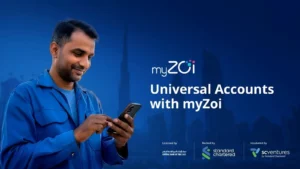



| Overview Financial inclusion in the UAE has reached 85.7% of residents aged 15 and older, yet significant gaps remain among migrant workers, women, and micro-enterprises. This guide examines how UAE banks, fintechs, telecoms, and regulatory bodies are addressing these gaps through digital wallets, simplified onboarding, mobile money platforms, and policy innovation. It outlines measurable outcomes, identifies barriers, and provides a practical roadmap for corporates designing their own financial inclusion programmes. |
A construction worker finishes a twelve-hour shift and checks his phone. His salary was processed this morning, but he cannot access it until tomorrow when the bank branch opens. His family back home is waiting for the remittance he promised to send. For employers managing thousands of workers in similar situations, this gap between salary processed and salary accessible creates operational friction, workforce dissatisfaction, and compliance risk.
Financial inclusion in the UAE is not just about opening bank accounts. It is about ensuring that every worker, regardless of income level, nationality, or documentation status, has timely access to wages, affordable remittance options, and financial tools that work in their daily reality.
What Is Financial Inclusion?
The World Bank defines financial inclusion as ensuring that individuals and businesses have access to useful and affordable financial products and services, transactions, payments, savings, credit, and insurance delivered responsibly and sustainably.
CGAP breaks this down into five operational pillars:
- Payments: Access to transaction accounts for wage receipt and bill payments
- Savings: Secure mechanisms to set aside money for future needs
- Credit: Responsible access to loans when required
- Insurance: Protection against financial shocks and risks
- Remittances: Affordable cross-border transfer services
Financial inclusion in the UAE is relatively high, with a large majority of adults having access to formal financial services. However, this aggregate progress conceals important disparities. Migrant workers, particularly in low-income sectors such as construction and hospitality, often face barriers related to documentation, mobility, and financial literacy. Similarly, women and micro-enterprises encounter structural and cost-related constraints that limit their effective participation in the formal financial system.
For UAE corporates, this creates both a workforce challenge and an opportunity. Workers without banking access struggle to save, send money home efficiently, or plan financially. Employers face payroll complexity, compliance exposure, and workforce dissatisfaction. Financial inclusion is where these two problems meet and where solutions must work for both.
Why It Matters for the UAE Economy
The UAE hosts approximately 8.7 million migrant workers, representing over 88% of the total population. For employers in construction, hospitality, manufacturing, and logistics, this workforce is essential. But many of these workers remain financially excluded not by choice, but by structural barriers.
A logistics manager coordinating shift workers across multiple sites knows the operational cost of delayed wage access. When salaries are processed but not immediately available, workers contact HR: complaints accumulate and trust erodes. For a workforce of 1,000, those are dozens of queries every pay cycle, each one a potential dispute or resignation.
| Did You Know? SMEs constitute more than 94% of all companies in the UAE and contribute approximately 60% to non-oil GDP, yet access to affordable credit and digital payment infrastructure remains a barrier to growth for micro and small enterprises. |
The UAE remittance market is worth around USD 45 billion, with outward remittances among the highest globally in 2023, making it the second-largest sender worldwide. India, Pakistan, Bangladesh, and the Philippines are the main recipients. For workers, smooth remittance channels mean more money reaches their families, while for the UAE economy, lowering remittance friction helps maintain workforce stability and supports healthy consumption patterns.
Barriers to Financial Inclusion in the UAE
The UAE’s Wages Protection System mandates electronic salary transfers for all private sector employers. Every worker receives wages through a registered bank account or approved digital channel. Compliance is high. Yet WPS ensures payment, not access. A worker may have wages deposited electronically but still lack control over when and how they use that money.
Documentation and KYC Requirements
Traditional banks require an Emirates ID, a residence visa, salary certificates, and proof of address. For workers on short-term contracts, those living in shared accommodation, or those with limited documentation, these requirements create barriers. Digital onboarding and eKYC (electronic Know Your Customer) infrastructure have reduced friction, but gaps remain.
Digital Literacy and Language
GSMA Mobile for Development research identifies digital literacy gaps and language barriers as significant obstacles, particularly among South Asian migrant workers with limited English or Arabic proficiency and minimal prior experience with smartphone-based financial services. Apps designed in English or Arabic only exclude users who need them most.
Cost and Accessibility
Remittance costs in the UAE are relatively low compared to global averages, reflecting strong competition among service providers and the growing adoption of digital and mobile-based transfer channels. While global remittance costs remain above the Sustainable Development Goal target of 3%, fees in major remittance corridors from the Gulf are typically significantly lower. Nevertheless, even small transaction costs can accumulate for low-income migrant workers who send money frequently, reducing the overall value of transfers received by their families.
Technology Enablers and Fintech Trends
The UAE ranks first in the Arab world and 11th globally in the UN E-Government Development Index 2024. Digital government services and eKYC infrastructure enable faster, lower-cost financial onboarding for previously excluded populations. Workers can verify identity electronically without visiting government offices or bank branches.
Mobile money adoption in MENA reached 59 million registered accounts in 2023, with digital wallets increasingly used for payroll disbursement, bill payments, and domestic remittances. This reduces reliance on cash and traditional banking branches. For corporates managing distributed workforces, mobile-first platforms allow salary disbursement without requiring every worker to have a traditional bank account.
Blockchain-based remittance platforms are emerging as alternatives to traditional money transfer operators. These platforms reduce intermediary costs and increase transfer speed. While adoption remains limited compared to established channels, the technology demonstrates potential for further cost reduction and transparency improvements.
Measuring Impact: KPIs & Reporting Frameworks
Corporate financial inclusion programmes require measurable outcomes not only for internal performance tracking but also for ESG reporting to investors, regulators, and stakeholders.
The UN Sustainable Development Goals provide a framework. SDG 8 (Decent Work and Economic Growth) and SDG 10 (Reduced Inequalities) include financial inclusion indicators: access to financial services, remittance cost reduction, and digital payment adoption. These metrics align directly with corporate initiatives targeting workforce financial well-being.
The Global Reporting Initiative (GRI) standards 401 (Employment) and 403 (Occupational Health and Safety) increasingly incorporate workforce financial well-being metrics. Payroll timeliness, access to savings mechanisms, and financial literacy support are material social performance indicators. Corporations reporting under GRI can demonstrate financial inclusion outcomes through:
- Account access rates: Percentage of workforce with active digital wallets or bank accounts
- Wage access speed: Time between payroll processing and worker access to funds
- Remittance cost benchmarks: Average fees paid by workers sending money home
- Financial literacy engagement: Workers completing financial education modules
| Did You Know? GRI-aligned ESG reports now require disclosure of workforce financial well-being metrics, making financial inclusion programmes a material component of social performance reporting, not just a corporate social responsibility initiative. |
How Businesses Can Start Their Own Programmes
UAE employers implementing digital payroll or financial inclusion programmes must ensure compliance with MOHRE’s Wages Protection System requirements, Central Bank SVF regulations if offering digital wallets, and UAE labour law provisions governing wage payment timing, transparency, and worker consent.
Step 1: Assess Current State
Map your workforce. How many workers currently lack bank accounts? How many use remittance services monthly? What languages do they speak? Where do compliance gaps exist: delayed wage access, unclear payslips, informal cash handling?
Step 2: Design Around Real Use Cases
Financial inclusion is not about features; it is about outcomes. Workers need faster wage access, lower remittance costs, transparent payslips, and financial literacy support. Design programmes that address these needs directly.
Step 3: Partner with Licensed Providers
The Central Bank of the UAE requires entities offering stored value facilities to obtain specific licensing, maintain minimum capital adequacy, implement AML/CFT controls, and ensure consumer fund protection. Building proprietary solutions requires regulatory investment that most corporates cannot justify. Partnering with licensed providers, banks, fintechs, or telecoms reduces regulatory burden and accelerates deployment.
Step 4: Pilot and Scale
Test initiatives with a subset of your workforce. Measure adoption, satisfaction, and operational impact. Identify friction points: onboarding complexity, language barriers, and technical support needs, and address them before scaling.
Step 5: Report Outcomes
Track KPIs aligned with GRI and UN SDG frameworks. Report financial inclusion outcomes in ESG disclosures. Transparency builds trust with workers, investors, and regulators.
| What You Can Do Begin with a workforce audit: how many employees lack banking access, what remittance corridors they use, and what barriers they report. Use this data to design targeted solutions rather than generic programmes. Partner with licensed providers who demonstrate regulatory compliance and consumer protection standards. |
The Road Ahead
Financial inclusion in the UAE is not an initiative; it is infrastructure. Workers need wages they can access immediately, affordable remittance channels, and financial tools that work in their language and match their digital literacy level. Employers need compliant payroll systems that reduce friction and build workforce trust.
Solutions like myZoi’s digital wallet demonstrate how licensed platforms can integrate payroll disbursement, remittance services, and financial literacy without requiring employers to overhaul existing systems.
Frequently Asked Questions
What is financial inclusion?
Financial inclusion ensures access to affordable, useful financial services, payments, savings, credit, insurance, and remittances, delivered responsibly. The World Bank defines it as essential for economic participation and stability.
What regulations apply to financial inclusion programmes in the UAE?
The Wages Protection System governs payroll disbursement. The Central Bank of the UAE regulates digital wallets under its Stored Value Facilities framework. Providers must meet consumer protection, capital, and AML/CFT requirements.
What budget is needed to launch a corporate financial inclusion programme?
Costs depend on the approach. Partnering with licensed fintechs has low integration costs, while building in-house requires significant capital, licensing, and compliance investment.
Should companies partner with fintechs or build their own solutions?
Partnering is faster, lower risk, and ensures compliance. Building requires licensing, capital adequacy, and ongoing regulatory oversight, viable mainly if financial services are core to the business.
How do we measure ROI on financial inclusion initiatives?
Measure retention, payroll efficiency, reduced HR queries, and ESG metrics aligned with United Nations SDGs and GRI standards. ROI includes cost savings and ESG gains.
Can financial inclusion programmes reduce compliance risk?
Yes. Timely wages, transparent payslips, and regulated disbursement channels reduce disputes and Ministry of Human Resources and Emiratisation penalties. Digital wallets also provide audit trails.
What role do telecoms play in financial inclusion?
Telecoms enable mobile money platforms for wages, payments, and remittances. These operate under the Central Bank’s SVF framework as regulated alternatives to banks.