


| Overview: Millions of workers in the UAE send money home every month without holding traditional bank accounts. This article covers legal methods to transfer money from the UAE: licensed digital wallets, prepaid cards, WPS salary cards, and cash pickup services and agent networks. Each section explains how the method works, what documents you need, transfer limits, and how to verify that a provider is legally licensed by the Central Bank of the UAE. |
You’ve just received your salary and need to send money to your family, but you don’t have a traditional bank account. This is not unusual. Many workers in the UAE send money without banks, using legal, regulated methods designed specifically for this purpose. From digital wallets to prepaid cards and agent services, you have options that comply with UAE Central Bank regulations and keep your money secure.
Legal Ways to Send Money Without a Bank Account: Quick Guide
The UAE Central Bank licenses multiple types of money transfer services that work without traditional bank accounts. Here’s a quick comparison of your main options.
| Method | Transfer Speed | Best For |
|---|---|---|
| Digital wallet apps | Minutes to 1 day | Regular transfers, tech-comfortable users |
| Prepaid cards | Minutes to 1 day | Workers who need a payment card too |
| WPS salary cards | Instant to 1 day | Workers receiving salary digitally |
| Cash pickup services | Minutes to hours | Urgent transfers, recipients without digital access |
| Exchange house agents | Minutes to hours | Walk-in service, established relationships |
Disclaimer: Transfer durations in the table are indicative averages and may vary by provider, corridor, and transaction details.
All legal transfer methods in the UAE require your Emirates ID for identity verification. This is a regulatory requirement under the UAE anti-money laundering rules, and is not optional. If a service provider doesn’t ask for your Emirates ID, it may not be legally licensed.
Digital Wallet & Money Transfer Apps in UAE
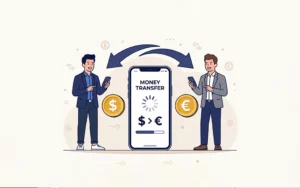
A digital wallet is a mobile app that stores money electronically and lets you send it abroad without needing a bank account. You load cash through agents or use it to receive your salary, then transfer money internationally through the app.
The Central Bank of UAE has licensed multiple mobile wallet operators under its Stored Value Facilities framework. myZoi’s digital wallet is designed for workers receiving WPS salaries. It enables instant access to wages and international transfers, and is licensed by CBUAE with multilingual support.
How to get started:
- Download the wallet app from your phone’s app store
- Register using your Emirates ID and mobile number
- Complete identity verification (usually a selfie and ID photo)
- Load cash at a participating agent or link your salary
- Select the country and amount you want to send
- Enter your recipient’s bank details or mobile wallet
- Confirm the exchange rate and fees before sending
Daily transfer limits typically start at AED 3,000-5,000 for basic verification. You can increase limits to AED 15,000-20,000 by providing additional documents like proof of address.
Security checklist:
- Enable biometric login (fingerprint or face recognition)
- Check the exchange rate markup; compare it to the mid-market rate
- Save your recipient details securely in the app
- Confirm the recipient’s name matches before each transfer
Prepaid and Salary Cards for Cash-to-Transfer
Prepaid cards and WPS salary cards convert cash or wages into a payment card you can use for remittances. Under the UAE’s Wages Protection System, employers can pay your salary directly to a WPS-compliant card even if you don’t have a bank account. This protects your right to receive wages on time.
Major exchange houses and licensed financial services issue prepaid Visa or Mastercard products. You load cash at their branches, and the card links to a mobile app that handles international transfers. The cards work at ATMs and shops worldwide, giving you flexibility beyond just your wages.
Step-by-step process:
- Visit a licensed exchange house or financial service provider
- Apply for a prepaid card using your Emirates ID
- Pay the card issuance fee (typically AED 25-50)
- Load cash at the counter; the amount goes onto your card
- Download the card’s linked app
- Use the app to send money internationally
Typical fees:
- Card issuance: One-time payment of AED 25-50
- Cash loading: Free to AED 5 per load
- International transfer: 2-4% of the amount
- ATM withdrawal: AED 10-15 per transaction
- Monthly card fee: AED 5-10
Monthly transfer limits typically range from AED 10,000 to AED 50,000, depending on your verification level.
| What to do if your card is lost Call the card issuer’s helpline immediately to freeze the card. Most providers charge AED 50-100 for a replacement card, but your remaining balance transfers to the new card. Keep your card details and helpline number saved separately from the card itself. |
Cash Pickup & Agent Services
Cash pickup services let you pay cash at a physical location in the UAE, and your receiver collects cash at an agent location in their country, often within minutes. This method doesn’t require you to have an account, just your Emirates ID.
This is the oldest method and is widely used for urgent transfers or by workers who prefer face-to-face service. Licensed money transfer operators run large agent networks across the UAE.
How cash pickup works:
- Find a licensed agent location near you
- Bring cash and your Emirates ID
- Tell the agent the destination country and amount
- Lock in the exchange rate and fee at the counter
- Pay cash plus the transfer fee
- Receive a transaction reference number
- Share the reference number with your recipient
- Your recipient shows ID at their local agent to collect cash
Transfer speed is typically minutes for standard service. The recipient usually has 45-90 days to collect the money, but this varies by destination country.
Typical fees range from AED 15 to 30 (fixed fee) plus a foreign exchange markup. For walk-in cash transfers without enhanced verification, you can typically send up to approximately AED 18,500 per day.
| Security reminder: Never share your transaction reference number publicly or with anyone except your intended recipient. Anyone with the reference number and matching ID details could potentially collect the money. |
Fees, Limits, and ID Requirements
Transfer costs have multiple parts, and understanding them helps you compare services accurately. According to World Bank remittance data, fees include:
- Fixed transaction fee: AED 10-30 per transfer
- Exchange rate markup: Difference between the mid-market rate and the rate you receive (usually 1-3%)
- Cash loading fee: AED 0-10 for prepaid cards
- Service charges: Monthly card fees or account maintenance
Under UAE regulations, transfer limits depend on your verification level:
| Verification Level | Documents Required | Typical Daily Limit | Monthly Limit |
|---|---|---|---|
| Basic | Emirates ID + phone number | AED 3,000–5,000 | AED 15,000–25,000 |
| Enhanced | Emirates ID + proof of address + salary certificate or income source | AED 10,000–20,000 | AED 50,000–150,000 |
Disclaimer: Exact limits vary by provider. Always check with your specific service provider.
Documents to keep handy:
- Valid Emirates ID (mandatory for all legal transfers)
- Proof of address (utility bill or tenancy contract for higher limits)
- Passport copy (some providers require this)
- Salary certificate (for very high transfer limits)
All legal money transfer services in the UAE must be licensed by the Central Bank. You can verify a provider’s licence status through the CBUAE website. Never use unlicensed informal transfer services, as they operate outside UAE law and offer no consumer protection if something goes wrong.
Choosing the Best Bank-Free Transfer Method
The right method depends on three factors: how quickly you need the money to arrive, how much you’re sending, and how your recipient prefers to receive it.
- Choose digital wallets if: You make regular transfers, you’re comfortable using apps, and your recipient has a bank account or mobile wallet.
- Choose prepaid or salary cards if: You need a payment card for everyday use alongside remittances, and you want one service for both.
- Choose cash pickup if: Your transfer is urgent, your recipient doesn’t have digital access, or you prefer face-to-face service.
Before sending, check the live exchange rate on a comparison site and calculate the total cost including all fees. The cheapest option for one amount might not be cheapest for another.
Expanding Access: Financial Services for Everyone
True financial inclusion means having real choices about how you manage and move your money. Whether you use a mobile app or an agent service, every legal transfer method in the UAE is built to work without requiring you to hold a traditional bank account. Explore how digital platforms like myZoi support accessible financial services for workers across the UAE.
Frequently Asked Questions
Q1: What is the maximum amount I can send in one day without a bank account?
With basic verification (Emirates ID only), most digital wallets and prepaid cards allow AED 3,000-5,000 daily. Enhanced verification with proof of address typically raises this to AED 15,000-30,000 daily. Cash pickup services at agent locations may allow up to approximately AED 18,500 per walk-in transaction without enhanced documents. Exact limits are different according to the provider; check your specific service’s terms.
Q2: Is Emirates ID mandatory for every money transfer app in the UAE?
Yes. Under UAE anti-money laundering regulations, all licensed money transfer operators must verify customer identity through Emirates ID. This is a legal requirement, not a provider choice. Services that don’t ask for Emirates ID are not legally licensed and should be avoided.
Q3: How long do cash pickup transfers stay available for collection?
Most cash pickup services hold funds for 45 to 90 days depending on the destination country. Some digital transfers initiated online offer a 24-hour window for urgent pickups. Always confirm the collection deadline with your provider and let your recipient know as soon as the transfer is sent.
Q4: Can I receive my salary on a mobile wallet instead of in a bank account?
Yes. Under the UAE’s Wages Protection System, employers can pay salaries to WPS-compliant digital wallets and prepaid cards. Your employer must use a MOHRE-approved payment channel. You have the legal right to receive wages through these non-bank options if your employer offers them.
Q5: Which remittance corridors from the UAE have the lowest fees?
The UAE-to-India, Pakistan, Philippines, Bangladesh, and Egypt corridors typically have the lowest fees, often 2–3% of the transfer amount, due to high competition and transfer volumes. Check the World Bank Remittance Prices Worldwide database for specific corridor comparisons and current rates.
Q6: What should I do if my transfer doesn’t reach my recipient?
Contact the transfer provider’s customer service immediately using the reference number from your transaction. All licensed providers are required to have dispute resolution processes. Keep all receipts and reference numbers. If the provider doesn’t resolve the issue, you can file a complaint with the Central Bank of the UAE’s consumer protection division.